
Monday to Saturday - 8:00 -17:30

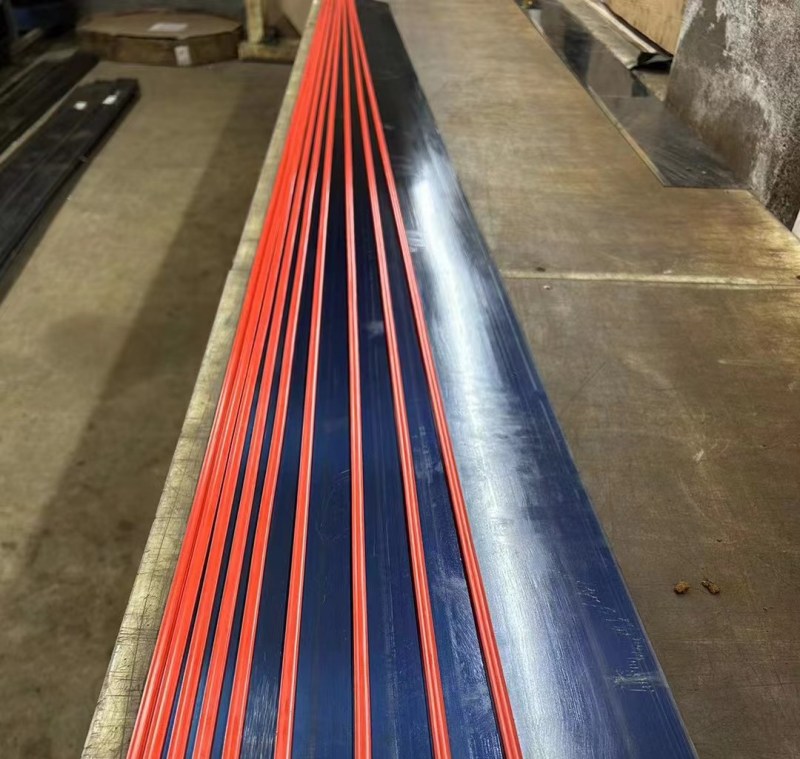
In the earliest blade coaters, the coating blade was mounted on the lower lip of the material tank, with pressure applied by the entire tank assembly pressing against the back roll. Since the blade formed an angle with the roll radius, it was deflected and generated a compressive force at the top. This load was found to control the coating weight, yet it remained inconsistent.
Rapid blade wear caused the square edge to wear into a beveled edge, which reduced the top specific pressure per unit area and lessened blade deflection. This performance was acceptable for low-basis-weight paper such as No.5 paper, but further research was still required. As inverted coating blades gained widespread use, in-depth research became increasingly urgent. It is essential that coating blades be perfectly flat and straight across the full width of the coater, with parallel edges and uniform thickness throughout.
Experience has proven that inclined blades are optimal for low coating weights, while curved or straight blades are suitable for high coating weights.
Inclined blades shall be pre-ground off-machine rather than ground on the coater. Practical experience also guides the selection of blade angles for specific paper grades and coating weights, as well as the timing for blade replacement. New blades must be individually polished with whetstones and inspected for burrs and cracks. All blades shall be treated for rust prevention and carefully packaged afterward.
Coaters are manufactured in a wide range of structural designs, requiring coating blades of varying widths and thicknesses accordingly. Blade thickness generally ranges from 2.5 to 7.6 mm. Blade width is divided into two functional sections: one clamped in the fixture and the other serving as the doctoring section. The clamped segment is typically 25 mm in width, while the section below 75 mm reserves space to extend the working stroke via pressure tubes or pressure bars. The actual effective doctoring edge of the blade normally measures 6 to 25 mm.
Blade lifting and positioning are adjusted by the hydraulic pressure of the coating material, machine operating speed, and the load exerted on the blade. Curved and straight blades deliver far lower specific pressure (kPa) per unit surface area than inclined blades, resulting in significantly slower wear rates.