
Monday to Saturday - 8:00 -17:30

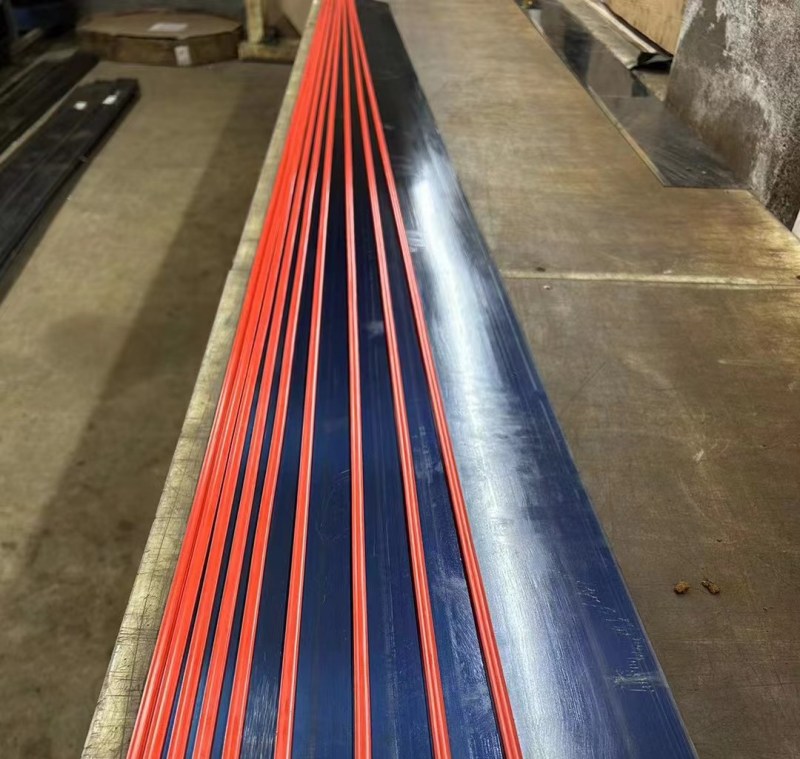
In the coating process, blade coating delivers coating liquid to the front of the slit between the coating blade and the substrate. Through the directional uniform or accelerated movement of the blade, the coating liquid is pushed and dragged to spread evenly on the substrate. After subsequent drying and curing, a required film layer is finally formed on the substrate surface.
As the core component of coating equipment, the coating blade’s performance directly determines the uniformity and quality of the coating layer as well as production efficiency, serving as the key to high-quality coating production. The blade edge directly contacts and scrapes off excess coating liquid, so it must feature excellent corrosion resistance, heat resistance and chemical resistance.
Coating blades are classified into hard blades and soft blades by material. Hard blades are manufactured with a preset grinding angle (e.g., 35°). In operation, their preset angle is generally equal to the included angle between the blade and the back roll, or 3°~5° larger. Soft blades usually have no preset grinding angle or only a tiny angle (e.g., 4°), and require rigid supports and a small working angle during application.
Hard blades enable easier and more accurate coating weight control with simpler operation. In contrast, soft blades are harder to regulate, yet they can achieve higher coating weight and deliver superior coating finish.